
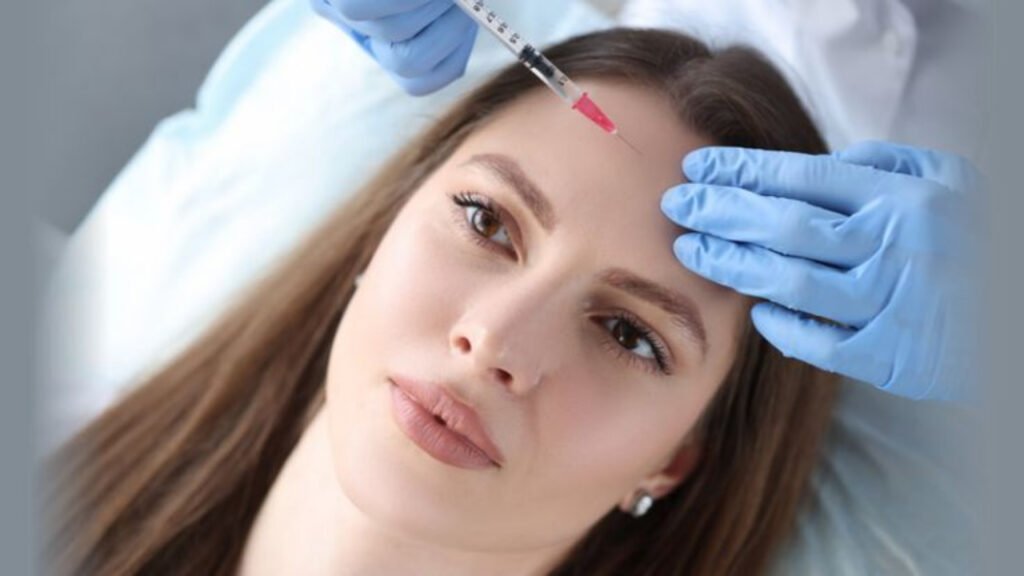
Forehead lines are often the first sign of aging that patients notice in the mirror, appearing years before other facial changes as expression lines etched by decades of raised eyebrows and furrowed brows. For women in Dubai considering treatment, understanding botox for forehead lines means knowing exactly what to expect: how it works, what results look like, and how to choose the right specialist. This guide covers everything from injection technique to aftercare, drawing on clinical experience with forehead wrinkle treatment across a wide range of skin types and ages.
Medically reviewed by Dr. Hessa Bin Haider, Board-Certified Dermatologist & Aesthetic Physician, DHA Licensed, with over 20 years of clinical experience in Dubai.
What Causes Forehead Lines?
Forehead lines form through a combination of repeated muscle movement and the skin’s gradual loss of structural support, and understanding this mechanism is the first step to treating them effectively.
The Role of the Frontalis, Corrugator, and Procerus Muscles
The frontalis muscle runs vertically across the forehead and is the primary muscle responsible for horizontal forehead lines. Every time you raise your eyebrows, whether in surprise, focus, or simply squinting against the sun, the frontalis contracts and the skin above it folds. Over years of repetition, these dynamic folds gradually become etched into the skin even at rest. The corrugator and procerus muscles sit lower, between and above the eyebrows, and are responsible for the vertical “11 lines” of the glabella. While botox for forehead lines specifically targets the frontalis, many treatment plans also address the corrugator and procerus together, since these three muscle groups interact and influence the overall look of the upper face.
Aging, Collagen Loss & UV/Sun Exposure
Muscle movement alone doesn’t explain why forehead lines deepen with age. Collagen and elastin production decline steadily after the mid-twenties, leaving skin less able to spring back after each muscle contraction. In Dubai’s climate, this process is often accelerated: intense, near year-round UV exposure breaks down collagen faster than in more temperate regions, and patients who spend significant time outdoors or commuting in bright sunlight frequently see forehead lines appear earlier than the global average. This makes daily sun protection one of the simplest, most effective ways to slow the formation of new lines alongside professional treatment.
Early sign to watch for:
Lines that appear only when you raise your eyebrows, not at rest, are the easiest to treat preventively.
Forehead lines are consistently ranked among the most common upper-face concerns patients raise with their dermatologist, alongside glabellar and crow’s feet lines. Botox itself has a well-documented regulatory history in this area: the FDA first approved onabotulinumtoxinA (Botox Cosmetic) for glabellar lines in 2002, and it wasn’t until 2017 that the same treatment received a separate FDA approval specifically for moderate-to-severe forehead lines, making it the first neurotoxin approved for three distinct facial areas.
How Botox for Forehead Lines Works
Botox for forehead lines works by temporarily interrupting the nerve signal that tells the frontalis muscle to contract, which is why understanding the underlying mechanism helps set realistic expectations for both timeline and results.
Botulinum Toxin Type A Mechanism
Botox is a purified form of botulinum toxin type A. When injected into the frontalis muscle, it blocks the release of acetylcholine, the neurotransmitter responsible for triggering muscle contraction, at the neuromuscular junction. Without that signal, the frontalis is unable to contract as forcefully, so the skin above it stops folding each time you raise your eyebrows. The muscle itself isn’t damaged or removed; it’s simply relaxed for a period of time, which is why the effect is temporary and fully reversible as the nerve signal gradually returns.
Botox vs. Filler: Why Botox Treats Movement, Not Volume
A common point of confusion for first-time patients is why Botox is recommended for forehead lines rather than filler. The two treatments address fundamentally different problems: Botox relaxes the muscle movement that creates dynamic lines, while filler adds volume to areas that have lost structural support, such as hollowed temples or flattened cheeks. Forehead lines are almost always a movement-driven concern, which is why Botox, not filler, is the appropriate first-line treatment. For a deeper comparison of when each is used, see our Botox vs Fillers guide.
Dr. Hessa’s take:
I rarely treat the forehead in isolation. The frontalis and glabella work together to hold your brow in a natural resting position, so when I plan a patient’s treatment, I’m balancing both areas rather than just softening lines. The goal is a forehead that still moves and expresses naturally, not one that looks frozen
Forehead Wrinkle Treatment Options Compared
Botox is the most common forehead wrinkle treatment, but it isn’t the only option, and knowing how it compares to fillers and skin-quality treatments helps you understand why your dermatologist may recommend one approach over another, or a combination.
Botox / Botulinum Toxin (Primary Focus)
As covered above, Botox relaxes the frontalis muscle to soften dynamic lines caused by repeated movement. It remains the gold-standard treatment for forehead lines specifically because it addresses the root cause: muscle activity, not lost volume or surface texture.
Dermal Fillers
Fillers are occasionally used on the forehead, typically to smooth deep static lines that remain visible even at rest, or to restore volume in cases of temple hollowing that affect the overall forehead contour. On their own, fillers don’t stop the muscle movement that creates the lines in the first place.
Skin-Quality Treatments
Botox and fillers address structure and movement, but they don’t improve the skin’s surface quality, texture, fine crepiness, or overall radiance. Treatments like HydraFacial and skin boosters work on a different layer of the problem, hydrating and refreshing the skin itself. At BHHC, these are often layered into a broader plan through our Full Face Skin renewal services, which combine targeted injectables with ongoing skin-quality maintenance.
| Treatment | Mechanism | Downtime | Duration | Best For |
| Botox | Relaxes frontalis muscle activity | None to minimal | 3–4 months | Dynamic lines from movement |
| Dermal Fillers | Adds volume beneath the skin | Mild swelling, 1–2 days | 6–18 months | Deep static lines, volume loss |
| Skin-Quality Treatments | Hydrates and refreshes skin surface | None to minimal | 4–6 weeks per session | Texture, radiance, fine crepiness |
Tip:
Combining Botox with a skin-quality treatment, such as HydraFacial or a skin booster, often produces longer-lasting smoothness than Botox alone.
What to Expect: The Botox for Forehead lines Treatment Process
Knowing what happens at each stage, from consultation to full results, helps patients feel confident going into their first session.
Consultation & Facial Assessment
Every treatment plan starts with a DHA-licensed consultation, where the dermatologist assesses your frontalis strength, brow position, and existing line depth at rest and at full expression. This mapping is personalized: muscle strength and injection points vary meaningfully from patient to patient, and a treatment plan built for one person’s anatomy rarely transfers exactly to another’s.
The Injection Procedure
The injection itself is quick, typically 10 to 15 minutes, using a fine needle across several points along the forehead. Most patients describe the sensation as a brief pinch rather than significant pain, and no anesthesia is required, though a topical numbing cream can be applied beforehand for sensitive patients. No incisions or downtime follow the procedure itself.
Onset Timeline
Initial softening is usually visible within 3 to 7 days as the frontalis begins to relax. Full effect typically develops by around 2 weeks, once the treatment has fully settled into the muscle.
Duration
Results generally last 3 to 4 months, after which muscle activity gradually returns and lines begin to reappear. Most patients schedule follow-up treatments on this cycle to maintain results.
Clinical trial data for onabotulinumtoxinA (Botox Cosmetic) supports this timeline: in trials assessing forehead lines specifically, 61% and 46% of patients across two studies showed at least a 2-grade improvement in line severity by day 30, compared with 0% and 1% of patients on placebo.
Botox for Forehead Lines: Before and After Results
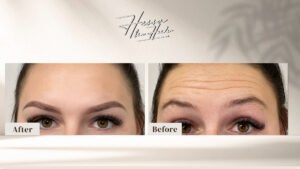
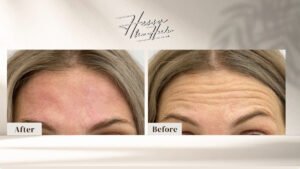
Photos are one of the clearest ways to set expectations before treatment, and seeing how forehead lines respond in real patients helps illustrate what “realistic” actually looks like.
What Realistic Results Look Like
Results vary depending on line depth, skin quality, and how long the lines have been present, but the pattern is consistent: dynamic lines soften first, followed by a gradual smoothing of finer surface lines over the following two weeks. Patients with early, expression-only lines typically see the most dramatic improvement, since the skin hasn’t yet developed the deeper static grooves that come with years of repeated movement. You can see this range of outcomes in our patient galleries, including the Forehead Renewal and Expression Lines case studies, which document real before-and-after progressions at 2 and 4 weeks post-treatment.
Dr. Hessa’s take:
“The result I’m aiming for is one where people notice you look rested, not that you had something done. I always under-treat before I over-treat, especially on a first visit. You can always add more at a follow-up, but you can’t take units back once they’re in. A forehead that still moves, just without the deep folds, is the goal, not one that’s completely still.”
Cost of Botox for Forehead Lines in Dubai
Cost is one of the first questions most patients ask, but it’s worth understanding what actually drives the number before comparing prices between clinics.
Price Range by Unit / Area
Across licensed Dubai clinics, botox for forehead lines typically falls in the AED 25 to 60 per unit range, with a standard forehead treatment using around 10 to 20 units. Priced by area rather than per unit, most clinics quote roughly AED 700 to 1,500 for the forehead alone. If you’re treating the forehead alongside the frown lines or crow’s feet as part of a fuller upper-face plan, expect a combined package closer to AED 2,000 to 4,000. These figures reflect general Dubai market ranges rather than a fixed price, since your exact cost depends on your specific treatment plan.
What Affects Cost
Three factors drive most of the variation in price: the number of units your muscle strength and line depth actually require, the experience level of the injecting physician, and the clinic’s overall positioning and reputation. A more experienced, board-certified dermatologist may charge more per unit than a less specialized provider, but that difference often reflects more precise dosing and a lower risk of complications or touch-ups, which affects the real cost of the treatment over time, not just the sticker price.
Tip:
Price shouldn’t be the deciding factor. Ask what’s included in the quote, such as the initial consultation, the follow-up touch-up policy, and whether the physician performing the injection is DHA-licensed.
Aftercare Tips for Forehead Botox
Following a few simple guidelines in the first 24 to 48 hours helps the treatment settle properly and reduces the risk of the toxin migrating to unintended muscles.
- Stay upright for at least 4 hours after treatment; avoid lying down or napping
- Skip strenuous exercise and heavy sweating for 24 hours
- Don’t rub, massage, or apply pressure to the treated area for at least 24 hours
- Avoid facials, saunas, or steam rooms for 24 to 48 hours
- Skip alcohol on the day of treatment to reduce bruising risk
- It’s fine to wash your face and apply makeup gently a few hours after treatment
Tip:
Dubai’s sun and heat can accelerate collagen breakdown, which shortens how long your results look their best. Daily SPF and staying well-hydrated won’t extend the muscle-relaxing effect itself, but they help maintain smoother, healthier-looking skin between sessions.
Why Choose Dr. Hessa Bin Haider for Forehead Botox in Dubai
Choosing the right physician matters more for Botox than almost any other cosmetic treatment, since technique and precision are what separate a natural-looking result from an obviously “done” one.
Dr. Hessa Bin Haider is a Board-Certified Dermatologist & Aesthetic Physician, DHA licensed, with over 20 years of clinical experience in Dubai. She has treated more than 15,000 patients, with a 98% satisfaction rate and a 4.9/5 rating across 312 Google reviews.
What sets her approach apart is a personalized muscle-balance philosophy: rather than treating the forehead in isolation, she assesses how the frontalis, glabella, and brow work together, so results look natural at rest and in motion, not frozen. Her clinic is based in Barsha Heights, Dubai, and her results are backed by a real patient gallery, not stock photography.
Ready to see what’s possible for your forehead lines?
Book a Consultation → WhatsApp us directly or use our online booking link to schedule your personalized assessment with Dr. Hessa.
FAQs
How long does Botox for forehead lines last?
Results typically last 3 to 4 months. Muscle activity gradually returns as the toxin wears off, and lines slowly reappear. Most patients schedule follow-up sessions every 3 to 4 months to maintain smooth results, though this can vary based on individual muscle strength and metabolism.
Is Botox for forehead lines painful?
Most patients describe it as a brief pinch rather than real pain. The injections use a very fine needle across several points, and the full process takes 10 to 15 minutes. Topical numbing cream is available for sensitive patients, though it usually isn’t necessary.
At what age should you start Botox forehead wrinkle treatment?
There’s no fixed age. Many patients start in their late twenties or early thirties as a preventive measure once expression lines begin appearing, while others begin later to treat established lines. Your dermatologist can advise based on your skin, muscle activity, and goals.
Can Botox forehead treatment look natural?
Yes, when dosed correctly. A skilled injector treats the frontalis in balance with the surrounding muscles, softening lines while preserving natural movement and expression. An overly frozen look usually results from over-treatment, not from Botox itself.
How much does Botox forehead Dubai treatment cost?
Botox for the forehead in Dubai typically costs AED 700 to 1,500 per session, depending on the number of units needed. Pricing varies by clinic, physician experience, and whether it’s combined with other treatment areas like the frown lines or crow’s feet.
Is Botox safe for first-time patients?
Yes, when administered by a licensed physician at a proper dose. Botox has a well-established safety profile and decades of clinical use. A thorough consultation beforehand, covering your medical history and goals, is the best way to ensure a safe, comfortable first experience.
https://www.pharmacytimes.com/view/fda-oks-third-indication-for-botox-cosmetic
https://www.botoxcosmetichcp.com/indications/ufl-indications