
Medically reviewed by Dr. Hessa Bin Haider, Board-Certified Dermatologist & Aesthetic Physician, DHA Licensed 20+ years’ experience, 15,000+ patients treated, 4.9/5 across 312 Google reviews.
Crow’s feet are often one of the first areas to reveal expression-driven aging, appearing at the outer corners of the eyes years before other facial lines become noticeable, especially for women living in sunnier climates where squinting and UV exposure accelerate the process. For patients in Dubai considering treatment, understanding botox for crow’s feet means knowing exactly what it involves: how the treatment works, what results to realistically expect, and how to choose a specialist who can preserve a natural smile. This guide covers the full process, from injection technique to aftercare, drawing on clinical experience with eye wrinkle treatment across a wide range of skin types and ages.
What Causes Crow’s Feet?
Crow’s feet form through the same basic combination that drives most expression lines: repeated muscle movement paired with the skin’s gradual loss of structural support, though the delicate skin around the eyes makes this area especially prone to early visible aging.
The Orbicularis Oculi Muscle and Its Role in Smiling and Squinting
The orbicularis oculi is a ring-shaped muscle that encircles the eye and controls blinking, smiling, and squinting. Every time you smile broadly or squint against bright light, this muscle contracts and pulls the surrounding skin into small folds radiating from the outer corner of the eye. In younger skin, these folds disappear as soon as the face relaxes. Over years of repeated contraction, though, the same folds gradually become etched into the skin, appearing even when the face is at rest. Because the orbicularis oculi is a single, continuous muscle rather than several smaller ones, botox for crow’s feet typically involves a few precisely placed injection points along its outer edge, rather than the multi-point approach used for a broader area like the forehead.
Skin Thinning, Collagen Loss & Sun Exposure Around the Eyes
The skin around the eyes is among the thinnest on the entire face, which means it shows the effects of collagen loss earlier and more visibly than skin elsewhere. Collagen and elastin production naturally decline from the mid-twenties onward, but in Dubai’s climate this decline is compounded by two additional factors: an exceptionally high UV index for most of the year, and near-constant squinting against bright, reflective light, both outdoors and while driving. This combination means crow’s feet often appear earlier, and progress faster, in patients living in Dubai compared with those in more temperate, lower-UV climates.
Tip:
Crow’s feet that only appear when you smile, not when your face is at rest, are dynamic lines and respond best to preventive treatment before they become permanent.
Crow’s feet have their own distinct regulatory history separate from forehead and frown lines. The FDA approved Botox specifically for the treatment of lateral canthal lines, the clinical term for crow’s feet, in 2013, following its earlier approvals for glabellar lines in 2002. This gave physicians an additional, dedicated approval for treating the eye area, rather than relying on off-label use of a toxin approved for other facial zones.
How Botox for Crow’s Feet Works
Botox for crow’s feet works by temporarily blocking the nerve signal that triggers the orbicularis oculi to contract, and because this muscle sits so close to the eye itself, understanding exactly how the treatment works helps explain why precision matters more here than almost anywhere else on the face.
How Botox Relaxes the Orbicularis Oculi
Botox is a purified form of botulinum toxin type A. When injected into the outer portion of the orbicularis oculi, it blocks the release of acetylcholine, the neurotransmitter responsible for triggering muscle contraction, at the neuromuscular junction. With that signal interrupted, the muscle contracts less forcefully each time you smile or squint, so the skin above it no longer folds into the same deep creases. The muscle isn’t damaged or permanently altered; it’s simply relaxed for a period of time, which is why the effect fades gradually as the nerve signal returns.
Botox vs. Under-Eye Filler: Why Crow’s Feet Need Muscle Relaxation, Not Volume
Patients sometimes assume that any line near the eye should be treated with filler, but crow’s feet and under-eye hollowing are different problems with different causes. Crow’s feet are movement-driven, caused by repeated contraction of the orbicularis oculi, while under-eye hollowing is a volume-loss problem, caused by fat and structural support diminishing beneath the skin. Filler cannot stop a muscle from contracting, and Botox cannot restore lost volume, which is why matching the treatment to the actual cause is essential.
Dr. Hessa’s take:
The eye area has some of the thinnest, most delicate skin on the face, so this is where precision matters most. I use very small, carefully placed doses around the outer eye, because the goal is to soften the crease without limiting how naturally you can still smile. A heavy hand here is where you start to see an unnatural result
Eye Wrinkle Treatment Options Compared
Botox is the most common eye wrinkle treatment for crow’s feet specifically, but it’s one part of a broader set of options for the eye area, and knowing how it compares to fillers and skin-quality treatments helps explain why your dermatologist may recommend combining more than one.
Botox / Botulinum Toxin
As covered above, Botox relaxes the orbicularis oculi to soften the dynamic lines caused by smiling and squinting. It remains the first-line treatment for crow’s feet specifically because it addresses the underlying cause, muscle movement, rather than a change in volume or skin texture.
Under-Eye Fillers & Tear Trough Treatment
Filler is used differently in this area, typically to address hollowing beneath the eye (the tear trough) rather than the crease lines at the outer corner. The two concerns often coexist but require separate treatment approaches, since filler cannot relax muscle movement and Botox cannot restore lost under-eye volume.
Skin-Quality Treatments
Botox and filler both address structure, either muscle activity or volume, but neither improves the surface quality of the thin skin around the eyes. Treatments like microneedling and skin boosters work on a different layer of the problem, improving hydration, fine texture, and overall resilience. At BHHC, these are often layered into a broader plan through our Under Eye and Full Face Skin services, which combine targeted injectables with ongoing skin-quality maintenance.
| Treatment | Mechanism | Downtime | Duration | Best For |
| Botox | Relaxes orbicularis oculi muscle activity | None to minimal | 3–4 months | Dynamic lines from smiling/squinting |
| Under-Eye Filler | Adds volume beneath the eye | Mild swelling, 1–2 days | 9–12 months | Tear trough hollowing, volume loss |
| Skin-Quality Treatments | Hydrates and refreshes skin surface | None to minimal | 4–6 weeks per session | Texture, fine lines, skin resilience |
Tip:
Pairing Botox with a hydrating skin booster around the eye area improves overall skin texture, not just the depth of the crease lines themselves
What to Expect: The Botox Crow’s Feet Treatment Process
Knowing what happens at each stage, from consultation to full results, helps patients feel confident going into treatment near such a sensitive area of the face.
Consultation & Assessment
Every treatment plan starts with a DHA-licensed consultation, where the dermatologist maps your individual smile pattern, assessing how the orbicularis oculi contracts at rest, at a soft smile, and at a full smile. This mapping matters because the muscle’s strength and the exact location of the lines vary meaningfully between patients, and a treatment plan built for one person’s smile pattern doesn’t transfer precisely to another’s.
The Injection Procedure
The injection itself is quick and involves only a few precisely placed points along the outer edge of each eye, using a very fine needle. Most patients describe minimal discomfort, often less than they expect, since the treated area is small and the needle used is extremely thin. No anesthesia is typically required, and the entire procedure is usually completed within 10 minutes.
Onset Timeline
Early softening is often visible within a few days, with some patients noticing initial changes even sooner. Full effect typically develops by around 2 weeks, once the treatment has fully settled into the muscle.
Duration
Results generally last 3 to 4 months, similar to other Botox treatment areas, after which muscle activity gradually returns and the lines begin to reappear with smiling and squinting.
Clinical trial data for onabotulinumtoxinA (Botox Cosmetic) supports this timeline: across two studies assessing lateral canthal lines specifically, 26.1% and 20.3% of patients achieved at least a 2-grade improvement in line severity at maximum smile by day 30, compared with 1.3% and 0% of patients on placebo.
Botox for Crow’s Feet: Before and After Results
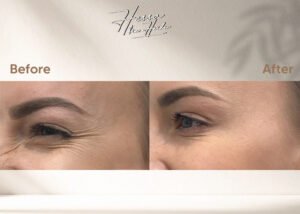
Photos are especially useful for setting expectations around the eyes, since this is an area where patients are often most concerned about looking “overdone,” and seeing real results helps clarify what a well-executed treatment actually looks like.
What Realistic Results Look Like
Results vary depending on how deep the lines are, how strong the underlying muscle contraction is, and how much sun exposure the skin has had over the years. The general pattern, though, is consistent: the fine lines that appear only with a full smile soften first, followed by a gradual smoothing of any lines that had started to show at rest. Patients with early, smile-only crow’s feet typically see the most noticeable improvement, since the skin hasn’t yet developed the deeper, permanent creases that come from years of repeated contraction
Dr. Hessa’s take:
Crow’s feet are one of the areas patients worry most about looking unnatural, and rightly so, because your smile is one of the most expressive parts of your face. My approach is always to soften the crease, not eliminate your ability to smile fully. If I ever have to choose between a slightly visible line and a smile that doesn’t move naturally, I choose the natural smile every time. You can always treat a bit more later; you can’t get natural movement back once it’s over-treated
Cost of Botox for Crow’s Feet in Dubai
Cost is one of the first questions most patients ask, but it helps to understand what actually drives the price before comparing quotes between clinics.
Price Range by Unit / Area
Across licensed Dubai clinics, botox crows feet dubai treatment typically falls in the AED 25 to 60 per unit range, with a standard crow’s feet treatment using around 10 to 24 units total across both eyes. Priced by area rather than per unit, most clinics quote roughly AED 600 to 1,400 for crow’s feet alone. If you’re treating the eye area alongside the forehead or frown lines as part of a fuller upper-face plan, expect a combined package closer to AED 2,000 to 4,000. These figures reflect general Dubai market ranges rather than a fixed price, since your exact cost depends on your individual muscle strength and treatment plan.
What Affects Cost
Three factors drive most of the variation in price: the number of units your muscle strength and line severity actually require, the experience level of the injecting physician, and whether the treatment is combined with other areas like the forehead or glabella. Because the eye area demands finer, more precise dosing than larger areas like the forehead, a more experienced physician’s pricing often reflects that added precision rather than simply a higher markup.
Tip:
Ask whether the quote includes follow-up touch-ups. The eye area often needs finer dose adjustment after the first session than other treatment zones, and knowing this is included upfront avoids unexpected costs later.
Aftercare Tips for Crow’s Feet Botox
The eye area is more delicate than other treatment zones, so following a few simple guidelines in the first 24 to 48 hours matters even more here to help the treatment settle properly.
- Stay upright for at least 4 hours after treatment; avoid lying down or napping
- Avoid rubbing, pressing, or massaging the eye area for at least 24 hours
- Skip strenuous exercise and heavy sweating for 24 hours
- Avoid saunas, steam rooms, or facials for 24 to 48 hours
- Skip alcohol on the day of treatment to reduce bruising risk
Tip:
The skin around the eyes is some of the thinnest on the face, and Dubai’s intense, near year-round sun exposure makes it especially vulnerable to UV damage. Wearing sunglasses and applying SPF daily won’t extend how long your Botox results last, but they help protect this delicate skin and keep it looking smoother between sessions
Why Choose Dr. Hessa Bin Haider for Crow’s Feet Botox in Dubai
Choosing the right physician matters especially for crow’s feet, since the eye area leaves very little room for error, and the difference between a soft, natural result and an overdone one often comes down to precision rather than the product itself.
Dr. Hessa Bin Haider is a Board-Certified Dermatologist & Aesthetic Physician, DHA licensed, with over 20 years of clinical experience in Dubai. She has treated more than 15,000 patients, with a 98% satisfaction rate and a 4.9/5 rating across 312 Google reviews.
What sets her approach apart is precision dosing around one of the face’s most delicate areas: rather than applying a standard dose across the board, she maps each patient’s individual smile pattern and adjusts accordingly, so results soften the lines without limiting natural expression. Her clinic is based in Barsha Heights, Dubai, and her results are backed by a real patient gallery, not stock photography.
Ready to see what’s possible for your crow’s feet?
Book a Consultation → WhatsApp us directly or use our online booking link to schedule your personalized assessment with Dr. Hessa.
FAQs
How long does Botox for crow’s feet last?
Results typically last 3 to 4 months, similar to other Botox treatment areas. Muscle activity gradually returns as the toxin wears off, and the lines slowly reappear with smiling and squinting. Most patients schedule follow-up sessions every 3 to 4 months to maintain smooth results.
Is Botox for crow’s feet painful?
Most patients report minimal discomfort, often less than expected, since only a few points are treated with a very fine needle. The full procedure typically takes under 10 minutes, and anesthesia usually isn’t necessary. Any sensation is generally described as a brief pinch rather than significant pain.
Can Botox for crow’s feet affect your smile?
When dosed correctly, no. A skilled injector uses precise, low doses that soften the crease lines while preserving your ability to smile fully and naturally. An overly frozen or restricted-looking smile is almost always a sign of over-treatment, not a necessary side effect of the treatment itself.
How soon will I see results from crow’s feet Botox?
Early softening is often visible within a few days, with the full effect developing by around 2 weeks. Results continue to settle slightly during this window as the treatment fully takes hold in the muscle, so it’s normal for the final result to look better at 2 weeks than at day 3 or 4.
How much does Botox crow’s feet Dubaiؤق treatment cost?
Botox for crow’s feet in Dubai typically costs AED 600 to 1,400 per session, depending on the number of units needed. Pricing varies by clinic, physician experience, and whether it’s combined with other treatment areas like the forehead or frown lines.
Is Botox safe near the eyes?
Yes, when administered by a licensed, experienced physician using precise technique. The eye area requires more careful, lower-volume dosing than larger facial zones, which is why choosing a specialist familiar with this specific anatomy matters more here than in most other treatment areas.
https://www.artemedica.com/fda-approves-new-indication-for-botox-cosmetic/
https://www.botoxcosmetichcp.com/indications/ufl-indications